|
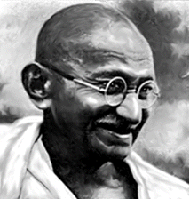
Mohandas Karamchand Gandhi (Gujarati: મોહનદાસ કરમચંદ ગાંધી, IAST: mohandās karamcand gāndhī, IPA: [moɦənd̪as kərəmtʃənd̪ gand̪ʱi], October 2, 1869 - January 30, 1948) was a major political and spiritual leader of India and the Indian independence movement. He was the pioneer of Satyagraha —resistance to tyranny through mass civil disobedience, firmly founded upon ahimsa or total non-violence—which led India to independence and inspired movements for civil rights and freedom across the world. Gandhi is commonly known in India and across the world as Mahatma Gandhi (Sanskrit: महात्मा mahātmā — "Great Soul") and as Bapu (Gujarati: બાપુ bāpu—"Father"). In India, he is officially accorded the honour of Father of the Nation and October 2, his birthday, is commemorated each year as Gandhi Jayanti , a national holiday. On 15 June 2007, the United Nations General Assembly unanimously adopted a resolution declaring October 2 to be the "International Day of Non-Violence." As a British-educated lawyer, Gandhi first employed his ideas of peaceful civil disobedience in the Indian community's struggle for civil rights in South Africa. Upon his return to India, he organized poor farmers and labourers to protest against oppressive taxation and widespread discrimination. Assuming leadership of the Indian National Congress, Gandhi led nationwide campaigns for the alleviation of poverty, for the liberation of women, for brotherhood amongst differing religions and ethnicities, for an end to untouchability and caste discrimination, and for the economic self-sufficiency of the nation, but above all for Swaraj —the independence of India from foreign domination. Gandhi famously led Indians in the disobedience of the salt tax on the 400 kilometre (248 miles) Dandi Salt March in 1930, and in an open call for the British to Quit India in 1942. He was imprisoned for many years on numerous occasions in both South Africa and India. Gandhi practised and advocated non-violence and truth, even in the most extreme situations. A student of Hindu philosophy, he lived simply, organizing an ashram that was self-sufficient in its needs. Making his own clothes—the traditional Indian dhoti and shawl woven with a charkha—he lived on a simple vegetarian diet. He used rigorous fasts, for long periods, for both self-purification and protest.
|